
Blockchain (from the English block chain, meaning "chain of blocks") is a data storage technology in which information is stored in a chain of sequentially linked blocks. Each block contains a unique code called a hash. It also contains the hash of the previous block in the chain. Once a record has been added to the blockchain, it cannot be altered.
And now, to understand it better, let us visualize and imagine blockchain as an accounting ledger with records, where blocks are pages, and transactions are the records on the page. The book is compiled according to strict rules: the pages (blocks) are numbered and follow a strict sequence (...1347, 1348...), being sewn into the book one after another. Each page has its own encoded code (hash), and it contains certain information and, importantly, a link to the previous page (block), which is also encrypted. If even one letter on the previous page is changed, the code of that page itself changes, and all subsequent pages must be changed as well. In other words, an already “sewn-in” page, and even the lines on that page, cannot be changed.
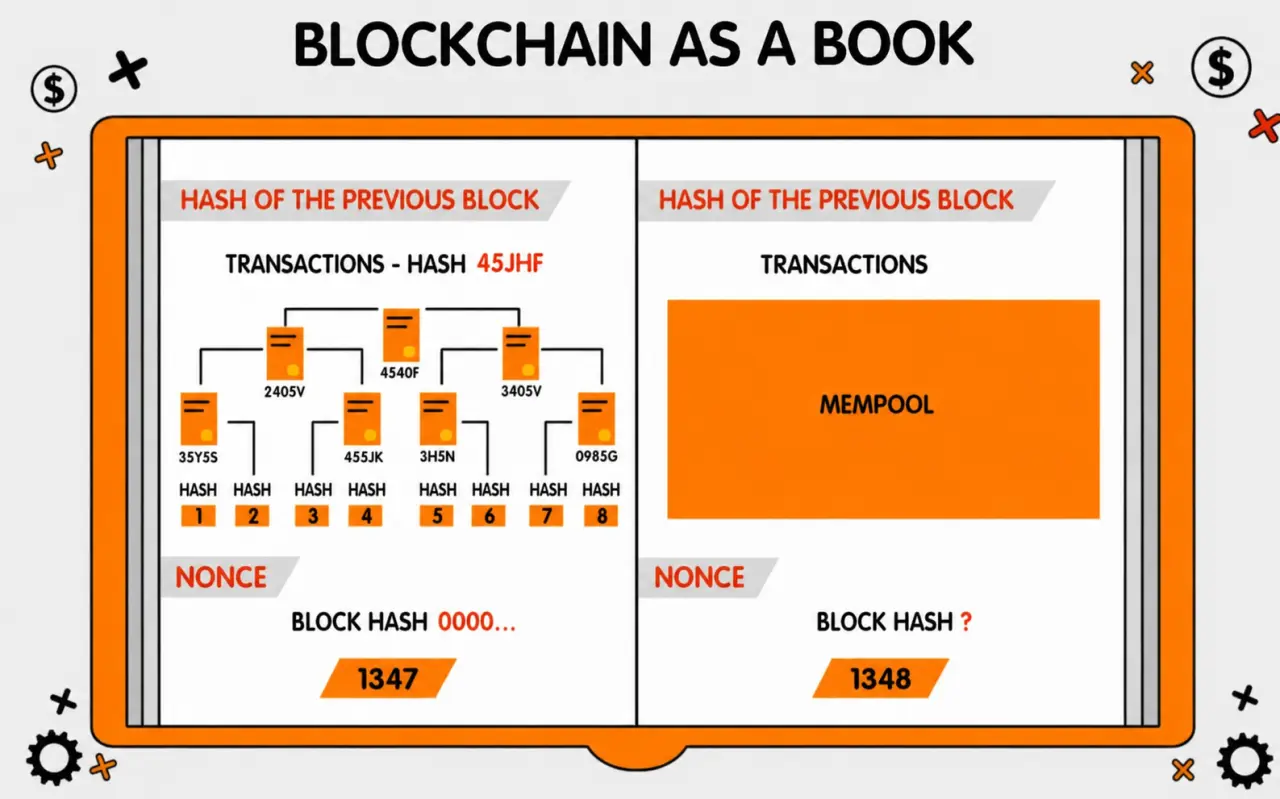
How Is Blockchain Different from a Traditional Database?
A traditional database is stored on dedicated servers controlled by an organization. Blockchain, on the other hand, is a distributed and decentralized system with no central authority, where all participants have equal rights.
Multiple copies of the blockchain are stored on its nodes (from the English word node). A node is any computer connected to the Bitcoin network that uses the P2P (peer-to-peer) protocol. This protocol enables nodes to communicate with one another, distribute information about transactions and blocks, and verify and update the blockchain.
To better understand this, imagine that our accounting ledger exists in electronic form and is duplicated across all computers (nodes). These copies of the ledger are constantly synchronized. If one computer fails, identical copies remain on many other computers, allowing the blockchain to continue operating without interruption.
There are full nodes and lightweight nodes. Without going into technical details, it is enough to know that full nodes are fully synchronized with the blockchain network. They store the complete blockchain data, meaning the entire version of our accounting ledger with all of its pages and all of its information. Full nodes download every block and every transaction and verify them according to the network's consensus rules.
Anyone can download the full copy of the blockchain. This information is publicly available, meaning it can also be stored on your own computer if you have sufficient storage and computing capacity. The blockchain is very large—for example, the Bitcoin blockchain currently exceeds 350 GB in size.
How Blockchain Works
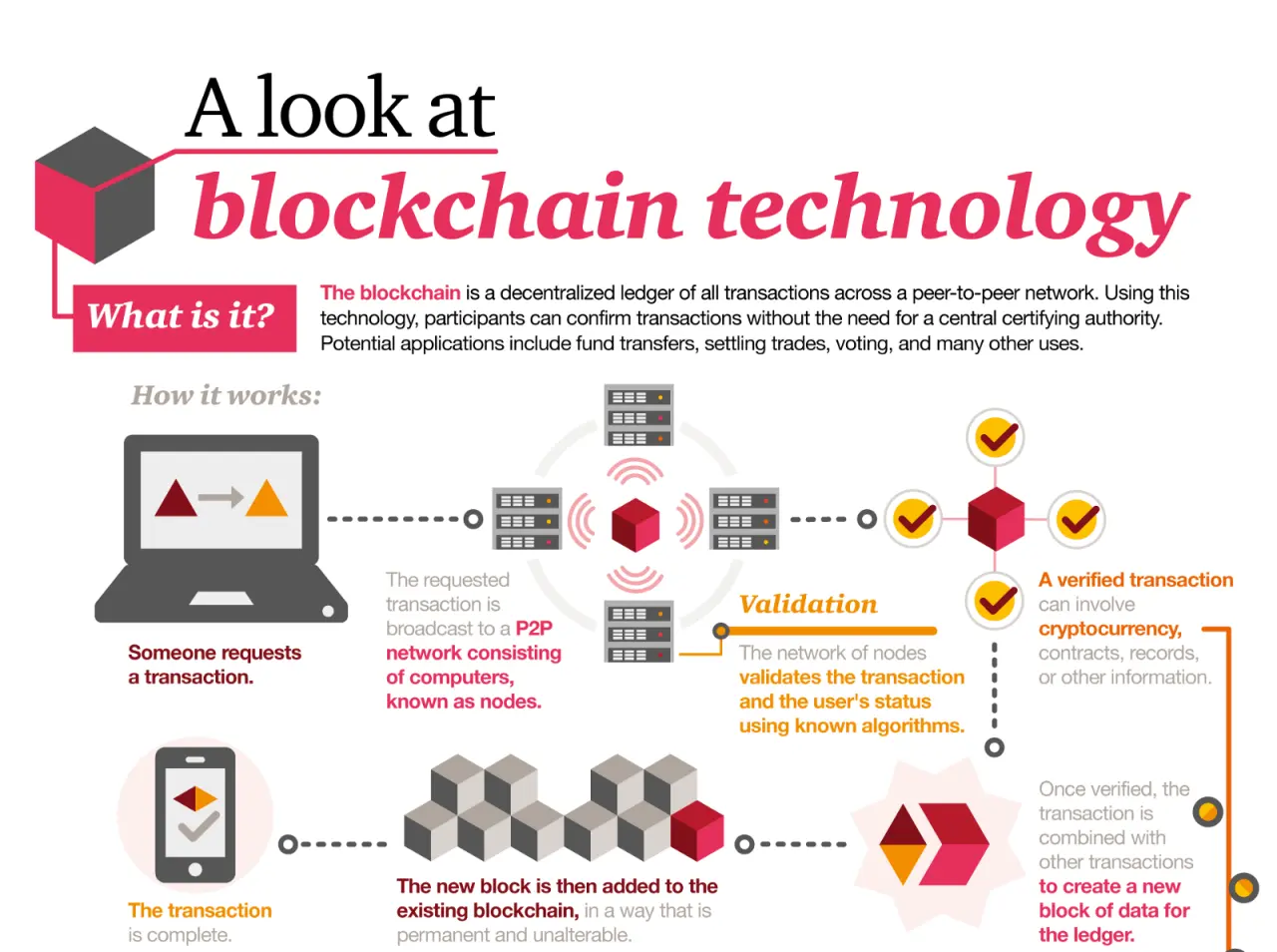
🔹 Verification and Validation of Information
In theory, any type of information can be recorded on a blockchain—from an entire collection of world literature to financial operations (such as confirming a money transfer), user identification (such as logging into a social network), and much more. It all depends on the purpose for which the blockchain was created. 1 blockchain = 1 type of information.
🔸 Verification and Validation of Information
When new information is submitted to the blockchain, it must be verified and confirmed by all participants in the blockchain network (the participants are the devices connected to the blockchain, which is why these operations are performed almost instantly). In mining, the verification and validation of information leading to the creation of a new block can be carried out using different consensus mechanisms, including PoS, PoW, and others.
🔹 Block Creation
Once all blockchain participants have confirmed the validity of the information, a new block is created containing several units of information (for example, multiple transactions). Each block contains not only the newly submitted information but also a timestamp and a reference to the previous block, allowing the contents of every block to be verified. This ensures the immutability of each block, meaning it cannot be altered after it has been created.
🔸 Adding a New Block to the Chain
The new block is then added sequentially to the existing chain of blocks. The blockchain contains information about every operation ever recorded in the database. Each participant records the new block in their own copy of the ledger, after which the information remains in the blockchain permanently. The block becomes the latest link in the chain, and anyone can verify its authenticity.
Advantages of Blockchain
The main advantages of the blockchain system include:
No intermediary. The system is balanced and relies on a large number of participants, ensuring its uninterrupted operation. No intermediary or third party is required to validate transactions. This is a significant advantage because intermediaries increase costs, reduce efficiency, and slow down the system.
Greater user empowerment. All users have equal rights, and there is no hierarchy within the network. Every participant is responsible for validating transactions and contributes to maintaining the independence of the system.
Integrity of processes. Blockchain follows a structured transaction validation process, allowing every participant to trust the system and the accuracy of its records.
Transparency and immutability. The principle of immutability means that no previous record or transaction can be deleted. This provides strong protection against fraud because no one can go back and alter a previous record, change a value, or modify information for personal gain. To make any change, a new transaction must be proposed to the network and approved by its participants.
Faster transactions. At present, this is not entirely the case, as Visa and Mastercard transactions are still processed faster. However, blockchain networks continue to improve and become more efficient. As mentioned earlier, the technology is still evolving. As more users join the network, the number of miners and validators increases, reducing transaction processing times. Many experts believe that blockchain will eventually surpass existing payment systems in terms of speed and become one of the fastest transaction networks available once it reaches broader adoption.
Lower transaction costs. The system is more cost-effective because it eliminates intermediaries, significantly reducing transaction costs.
Blockchain Use Cases
Blockchain was specifically designed for storing and managing information. Because it significantly reduces software costs, shortens processing time, and improves security, the technology is gradually being adopted across many industries—and in some sectors, it is already widely used today.
Identity Management
Identity management services allow users to store their personal information on a blockchain, creating a Digital Identity. This enables users to securely store information such as passport details, birth and marriage certificates, driver's licenses, identity documents, usernames, passwords, and other personal data. Using blockchain, users can decide exactly what information they wish to share and who is allowed to access it. Moreover, after completing identity verification once, users can authenticate themselves across other services without repeatedly submitting the same information.
Payments
Blockchain is particularly well suited for the financial industry, especially for international and cross-border payments. International transfers typically require considerable time, involve multiple intermediaries, and incur significant costs. By using blockchain, transaction times can be greatly reduced, costs lowered, and the need for complex intermediary infrastructure eliminated.
Copyright Protection
Copyright infringement remains one of the biggest challenges in industries such as art, music, film, and literature. Blockchain enables creators to verify and protect their copyrights and intellectual property rights. In addition, the technology provides secure storage and efficient updating of information related to any intellectual property asset.
Smart Contracts
Smart contracts are algorithms that enable self-executing agreements on a blockchain. These contracts are ideal for commercial transactions because they automatically transfer funds or execute other agreed actions as soon as all parties fulfill the obligations specified in the contract. Smart contracts operate without intermediaries and execute automatically, making them particularly useful for startups and modern businesses.
Electronic Voting
Blockchain technology can enable governments to implement fully transparent electronic voting systems that allow voters to verify their own votes. Citizens would authenticate themselves within the system and vote for their chosen candidate using an internal digital token. Blockchain records every transaction, automatically creating an immutable register of votes that is counted once voting has ended. Each participant can verify both their own vote and the accuracy of the overall vote count. The Yerevan Municipality has already implemented this technology. The Activecitizen.am platform allows citizens to submit proposals about how they would like to see their city develop, review proposals submitted by other residents of Yerevan, and vote for them. All voting data is recorded on the blockchain.
Without question, the leading application of blockchain technology today is financial transactions, both with cryptocurrencies and with traditional fiat currencies.
How Is Cryptocurrency Related to Blockchain?
Cryptocurrency is a digital or virtual currency designed to function as a medium of exchange. It uses cryptography to secure and verify transactions, as well as to control the creation of new units of a particular cryptocurrency.
Many people are attracted to the technology behind cryptocurrencies—blockchain—because it is a decentralized system for processing and recording data that can be more secure than traditional payment systems. However, if we set aside all the hype surrounding cryptocurrencies, we can understand that they are essentially records stored in a database that cannot be altered unless specific conditions are met.
The price of a cryptocurrency is determined solely by what people are willing to pay for it. In other words, its value is driven entirely by supply and demand.
So how are these two concepts connected? Cryptocurrencies operate on blockchain technology. In other words, blockchain is the underlying technology that powers cryptocurrencies, but it can also be implemented across many industries beyond finance. These two concepts go hand in hand, and one is necessary for the existence of the other.
Therefore, it is important to understand that cryptocurrency and Bitcoin are NOT the same as blockchain. Because Bitcoin is much more widely known than the underlying blockchain technology, people often confuse these terms. As we have seen above, blockchain is not limited to cryptocurrencies—its range of applications is far broader.
Summary
Blockchain is a distributed database management system, or in other words, a peer-to-peer distributed ledger.
Blockchain is a system in which every participant acts as a point of control, and all participants are essentially equal. The network is maintained through the interaction of its participants.
Every participant in the system maintains a complete copy of the database or, in technical terms, the entire transaction ledger. As a result, every participant has access to the complete list and history of all transactions ever carried out within that particular network. This is the foundation of blockchain's transparency.
A transaction is considered confirmed only after it has been approved by the majority of network participants. Every transaction requires consensus. This is achieved through consensus algorithms and cryptographic hash functions, making attacks on the network economically impractical and ensuring that only transactions approved by the majority of participants are recorded.
Using blockchain, it is possible to transfer virtually any type of value. It does not have to be cryptocurrency or information. Any asset or ownership right can be transferred through the network.
Blockchain is the technology that forms the foundation of the Bitcoin system. In 2008, when Satoshi Nakamotopublished the white paper describing the peer-to-peer system called Bitcoin, people initially focused on experimenting with the concept of Bitcoin. Later, they realized that the underlying technology of this system could be applied to many other use cases. That technology became known as blockchain.
Blockchain is not Bitcoin. Many people confuse the terms "Bitcoin" and "blockchain," assuming they mean the same thing. In reality, blockchain is the underlying technology on which the Bitcoin system is built. Blockchain is a technology with a wide range of applications across many industries, which will be discussed in future lessons. Bitcoin is simply one of those applications—it uses blockchain technology.